
Understand the situation
I talk to the people commissioning the day and to selected members of the audience, review the information available and recognise which questions are named officially – and which lie beneath them.
In-house assistant days and assistant conferences
An assistant day makes appreciation visible, strengthens the internal network and translates new demands into concrete next steps – ambitious enough for tomorrow and connected to today's working reality.

Never over the audience's heads
The core of the content
Which questions really matter to your assistants? Together, we clarify your audience's challenges and development goals. I use these to design a programme with relevant talks, workshops and room for networking. Whether the focus is AI in everyday assistant work, collaboration or a changing understanding of the role, the topics and formats are tailored to your organisation.
I talk to the people commissioning the day and to selected members of the audience, review the information available and recognise which questions are named officially – and which lie beneath them.
Company goals, the current role and actual needs shape a central idea for your assistant day. I use it to select topics, formats and speakers and bring them together in a schedule with shared talks, deeper exploration and exchange.
Example of an in-house assistant day
A compact assistant day can provide orientation, allow individual deep dives and get people talking to each other. This real programme principle shows how much fits into one day without overloading it.
An accessible talk on AI and changing roles creates a shared starting point – engaging, relevant and without technology overload.
AI, productivity, presence, resilience, change and leading without formal authority: participants go deeper into whatever fits their situation.
Changeovers and breaks are part of the dramaturgy. They make exchange possible and turn individual participants into a network.
The shared closing brings the day together and translates new perspectives into one concrete next step for everyday work.
The principle: shared focus, personal choice, real encounters and a closing that sparks transfer.
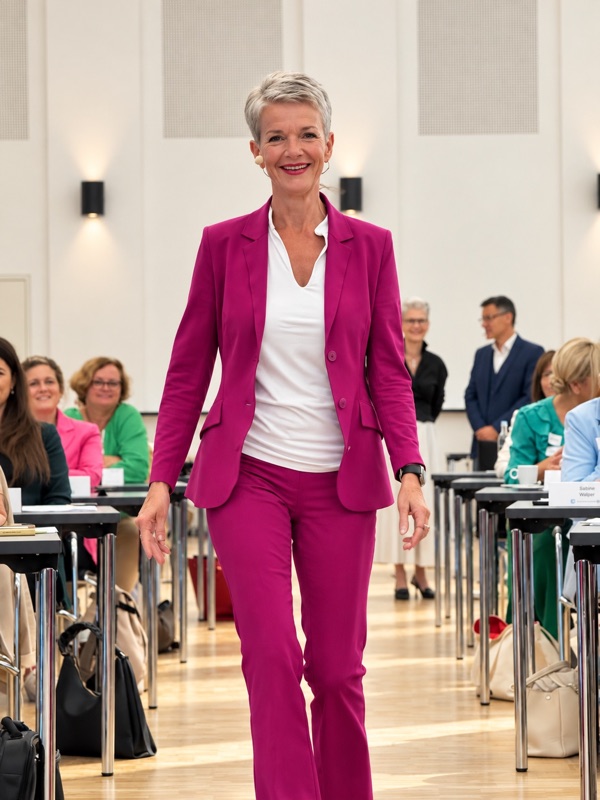
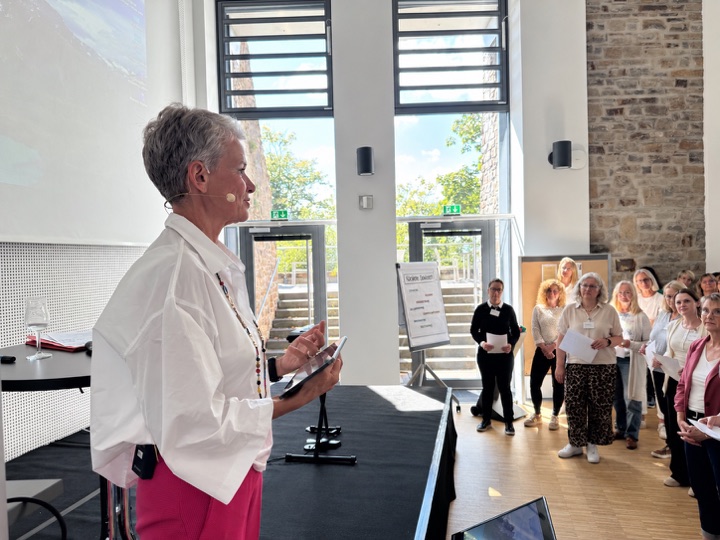
A glimpse into the room
A short look at the energy that builds when people do not just listen but become active together.
When there is more room
For organisations that want to invest more time, a multi-day assistant conference can bring different needs together in a meaningful way:
A protected space for exchange: what is already working? Where are things stuck? What can colleagues learn from each other?
New methods, processes and technologies become understandable, concrete and applicable to each person's everyday work.
Self-leadership, communication, visibility and collaboration strengthen the ability to actively fill the new role.
No rigid three-day package. A compact specialist day or a different sequence can also be right. What counts is the impact, not the template.
Possible topic areas
The following topics could form the focus of your assistant conference. We decide which are relevant and how much time they need by looking at your goals and your assistants' working context. One shared question connects the contributions.
How are responsibilities changing, and what does that mean for each person's contribution? The focus is on understanding the role, shaping decisions and working with leaders.
Where can AI and digital tools support everyday assistant work? Possible areas include practical applications, suitable workflows and making sense of new possibilities.
Clarifying expectations, communicating confidently and making your contribution visible: these topics address collaboration with leaders, teams and colleagues across the organisation.
How can assistants set priorities and maintain boundaries when demands compete? Relevant talks and exercises can cover decision-making, personal organisation and resilience.
Assistants share experiences, learn from each other and develop next steps for their everyday work. Exchange and networking are deliberately built into the programme.
Experience in the room
I worked as an executive assistant to a management board myself and know how demanding this role can be. On top of that come eight assistant conferences that I designed and accompanied myself.
This experience helps me a great deal today. I know which topics really occupy assistants, which speakers look strong on paper but do not land in the room – and when it is better to get people talking to each other instead of adding yet another talk.
Even so, I never walk into an assignment with a ready-made concept. In our conversations I listen closely: what is different this time? What does this group need? And what should stick at the end of the day?
I work with organisations in Germany, Austria and Switzerland. Conference design and collaboration are possible in German or English; on stage, I moderate in German.
What I can take on
Are you organising an assistant day and need support with the concept, programme or delivery? You can commission individual services or support throughout these stages. I keep the content connections in view and raise contradictions or gaps early.
Audience analysis, central idea, topic areas, dramaturgy and formats.
Research, selection, outreach, coordination and content briefing.
Preparation and personal moderation in German with clear transitions, participation and a common thread in content.
Personal view, capacities and waiting list, booking and cancelling tracks, reminders, feedback and evaluation.
Price after our first conversation – matched to scope, preparatory work and area of responsibility.
Conference design in detailVoices from practice
The quotes come from anonymous written feedback collected after the events – which is why no names are given. They are translated from German. They show what counts alongside good content: the right mix, room for exchange and topics that fit the work of assistants.
The forum is not only about learning and taking content home – it also offers a wonderful opportunity to network. The balance between the two is perfect, which is why I would recommend this forum to every assistant. The contributions are wonderfully chosen by Andrea and perfectly matched to the work of assistants. I always enjoy coming back to the forum and have already encouraged one or two colleagues to come along.
Andrea Kaden is an absolute asset to this format, and with her manner and the topics she brings, she makes the forum an absolute highlight.
The mix was very good. Day one: lots of input on the core topic of AI. Day two: more of a personal touch. I really liked it.
The combination of speakers and topics was very good. The highly complex topic of AI was explored excellently, both in general and specifically for our area of work, and the talk on resilience on the second day was outstanding. Exchange was well supported despite the large group.
This was already the third event I was able to attend – and once again the topics were a perfect fit. This event is always worth a clear recommendation. Both the talks and the personal exchange were extremely enriching. A heartfelt thank you to the ADG team and to Andrea Kaden for the usual perfect preparation and smooth running.
In brief
No. What matters is that a group of assistants shares common topics, changes or development goals. Scope and format are adapted to group size and starting point.
No. One of the most important parts of my work is precisely to develop robust focus topics from your goals, from conversations and from the reality of the audience.
Yes. I still check whether topics, sequence and profiles fit together, and point out overlaps or gaps openly.
Yes. Together we look at previous feedback, current goals and how the audience's situation has changed. The result is not a complete restart at any cost, but the right next development.
Let's get started
Tell me what you have in mind. In a free 30-minute call we clarify what your conference needs and whether I am the right person for it.
Book 30 minutes